If you know someone who should see this
Someone I trust asked me for one pager illustrating what this Future Proofing Thing is.

He works at a level where introductions happen in a single sentence, and he wanted something he could put in front of people without having to explain it first. Not a brochure. One page he could hand over and let do its own work.
It took a morning and it turned into two sides. Everything on it is reproduced below, so you can read it here without opening anything — and there is a link at the end to the PDF itself, which is the thing you would actually forward.
Before you send it to anyone, spend six minutes.
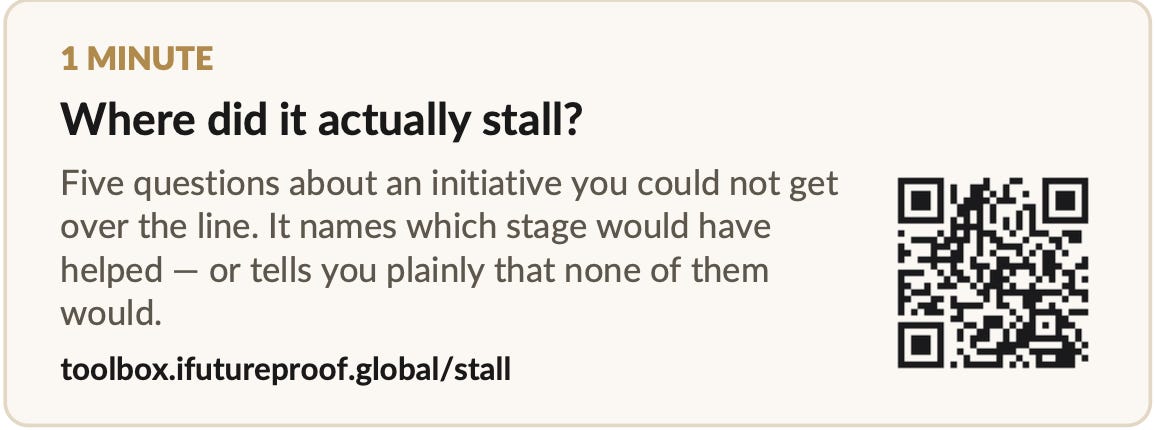
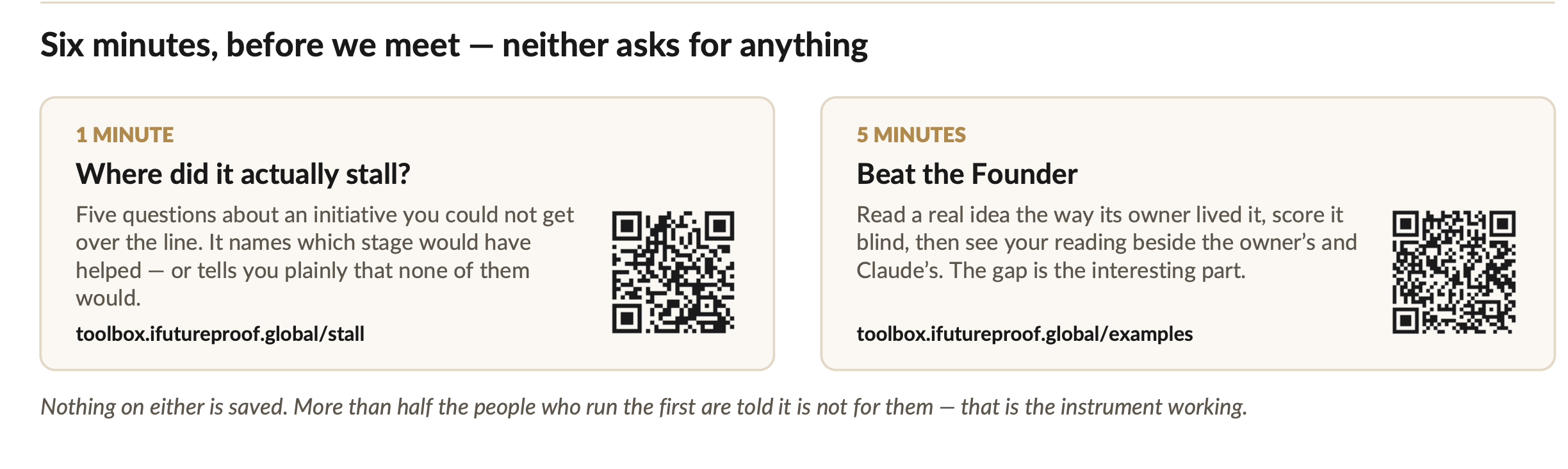
Where did it actually stall — one minute. Five questions about an idea you could not get over the line. It names which stage would have helped, or tells you plainly that none of them would.
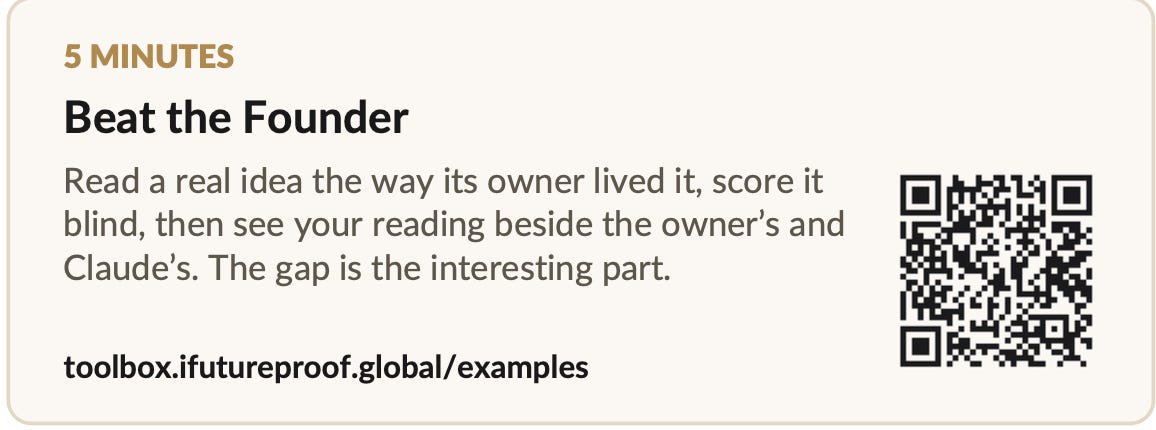
Beat the Founder — five minutes. Read a real idea the way its owner lived it, score it blind, then see your reading beside the owner’s and Claude’s. The gap is the interesting part.
I recommend you both. Not because you need convincing, but because a member who has run them can say so in the first line of an introduction, and that is worth more than anything I could write for you.
And there is a second reason. More than half the people who run the first one are told it is not for them. You should watch that happen before you send anyone to it — because that refusal is the thing protecting your name in this arrangement, and I will come back to it at the end.
The page itself
i-Future Proof makes one question answerable before you spend the money: would it be worth it?
Only the people who would have to live with it can answer that. They tell you by using it — or quietly not at all.
Why that question has never been answerable
Worth it is a comparison, and both sides of it have gone unmeasured.
On one side: what actually changes for a person — whether their state improves, by how much, and for how long.
On the other: what it costs them of themselves. Not the budget — the attention, the effort, the disruption, the courage it takes to work differently. People do not adopt what costs them more than it gives them, and nobody has ever counted that side.
A business case measures neither. It sets the organisation’s money against the organisation’s forecast money, and files everything that actually decides the outcome as intangible.
We measure both sides, with the people themselves, and set the two readings side by side. We never divide them — divide, and you have invented a number nobody lives.
And one result that surprises everyone: unlike money and time, human capacity grows when it is exercised. The people who invest early invest more later, not less. It is a measurable property of real systems, and no ledger has a column for it.
Why the answer matters
If the people who would have to live with it judge that it is not worth it, they do not adopt it — and they rarely say so. They work around it, use the minimum, and go back to what they had. The system exists, the programme is recorded as delivered, and the benefit never arrives. Most failure looks like that: not a collapse, a shrug. Meanwhile the cost does not stop.
More than 7 in 10 funded initiatives fail the business that paid for them. Of more than 16,000 major projects, 8.5% came in on time and on budget; half of one percent did that and delivered the promised benefits.
And a no is not a dead end. Where the answer is close, it names what would have to change to make it worth it, and to whom — the cheapest specification you will ever be handed.
How it works

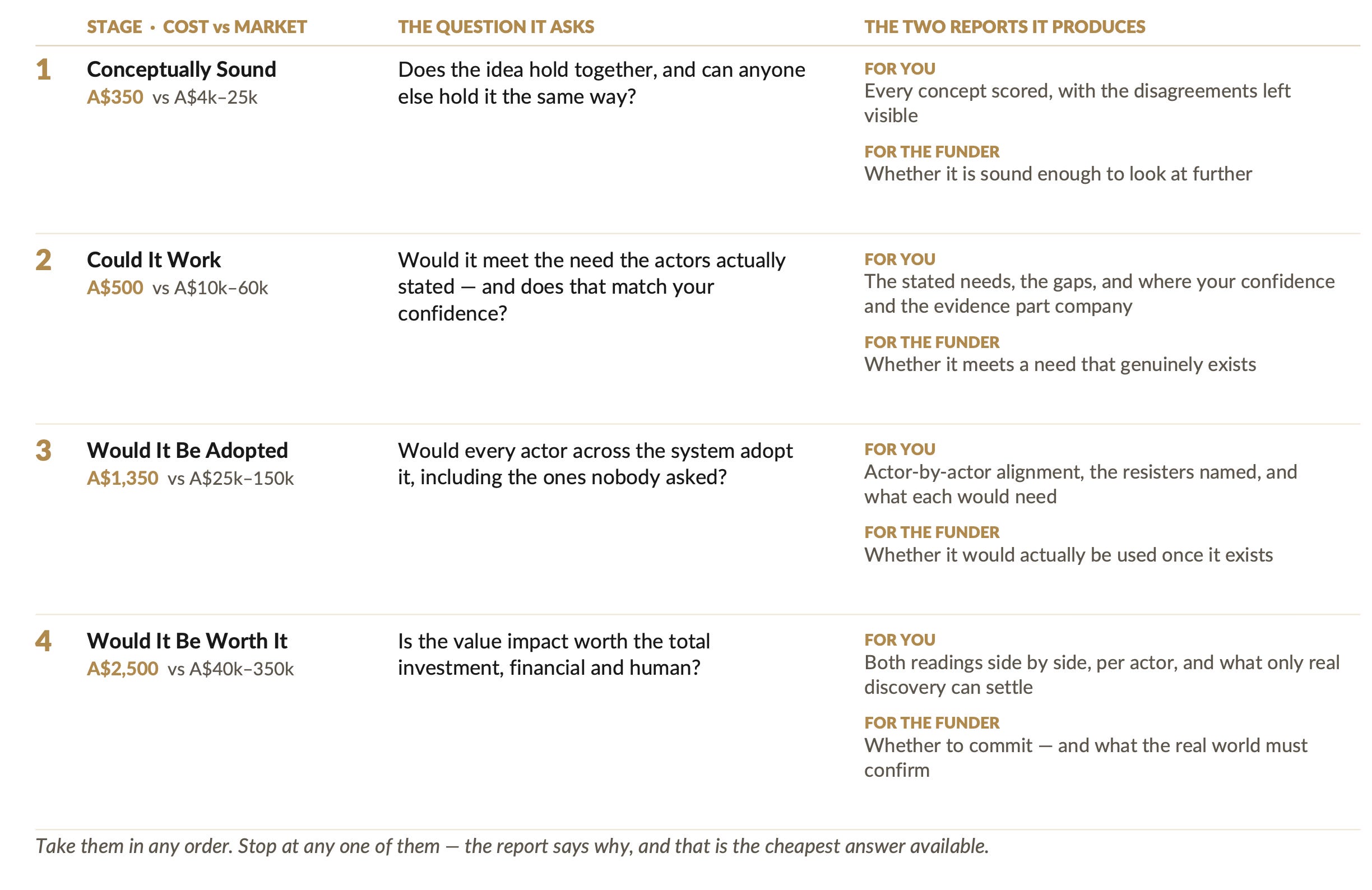
Capital is committed at the last rung, not the first. Any rung can stop you, and stopping early is the cheapest good news available.
Four questions, in order
1 Does the idea hold together? 2 Would it meet the need the actors actually stated? 3 Would every actor across the system adopt it — including the ones nobody asked? 4 Would it be worth it?
A$350 to A$2,500 a stage; A$3,750 for all four. Commissioned from a consultancy, the same four reads are quoted between A$80,000 and A$585,000 — and either figure is small against the initiative it might stop.
“When it comes to understanding and leveraging the value that comes from a network of operators working together, traditional methods are no longer applicable or useful. Stephen’s value methodology solves that problem — and also indicates where the project and the enterprise will arrive through the creation and use of digital value.”
Jane Treadwell — Strategic Adviser, International, Government Transformation · formerly AWS and the World Bank Group
The next step is a conversation, not a proposal. Half an hour, walking through it against something you are actually deciding — so you can judge whether it addresses a need I have no way of guessing from here.
Side two — what the thirty minutes would cover
About fifteen of it is the thing itself, run live on an idea of yours; the rest is your questions.
How it can possibly know — and why it is not a survey
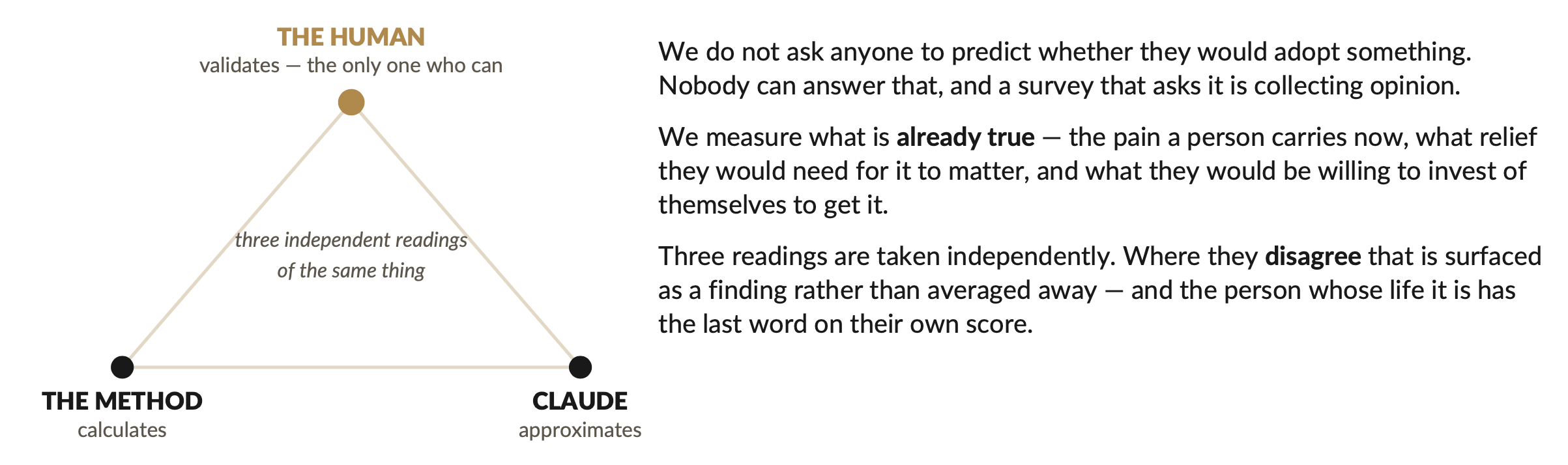
Four stages. Each asks one question. Each answers to two readers.
How can you use this?
Download the one-pager PDF, two sides
It is designed to be printed as well as read on screen, which is why the two experiences appear on it as QR codes rather than links.
The words to use
Do not compose this yourself. A member who writes their own version either overclaims or undersells, and both cost you.
This is Stephen Alexander. He has a way of finding out whether an initiative would actually be worth it to the people who would have to live with it, before the money is committed.
One page attached, both sides. If it is not relevant to you it will be obvious inside a minute and no harm done.
If it is, he will give you half an hour and run it live on something you are actually deciding.
Four lines. No adjectives. The escape hatch in the middle is what makes it easy to send and easy to receive.
What happens on the call
Half an hour. About fifteen minutes of it is the thing running live on an idea of theirs — not a demonstration on a case study, their own initiative. The rest is their questions.
No deck. No proposal. If it is not a fit, I will say so on the call rather than in a follow-up email a week later.
Why it is safe to refer someone
An introduction spends your credibility, not your money. So the honest question is what happens to your standing if the fit turns out to be wrong.
The answer is that the instrument refuses people. The quiz sends most of them away. The stages can come back no. And I will tell your contact plainly on the call if this is not for them — which leaves them thinking you sent them someone straight, rather than someone selling.
That is a better reason to refer than any commission, and it is the one I would rather you relied on.
When not to send it
Three situations where I would rather you did not.
There is no sponsor. If your contact has no authority to decide and no line to someone who has, nothing here fixes that. It can make a case unarguable; it cannot make a decision-maker exist.
The decision is already made. If the direction is set for reasons that have nothing to do with evidence, evidence will not move it — and anyone who tells you otherwise is selling something.
It is too early. If nobody can yet name the people whose behaviour would have to change, every stage would be measuring fog. Come back when three of them can be named.
Sending it in those three cases costs you more than it costs me. Fewer, better introductions are worth more to both of us.
The arrangement
If an introduction you make turns into paid work, you share in it.
The amount depends on what results — a proof of concept, a licence and an enterprise instance are very different things — so I am not going to publish a percentage I would have to walk back. I will agree it with you before anything is signed, not after.
One practical rule, and it exists to protect the goodwill rather than to police it: tell me before you make the introduction. A one-line message is enough. It puts it on record from the start, and it means neither of us is ever reconstructing who brought whom, months later, from memory. If you would like to attend the meeting that would be wonderful, you set the rules, not me. Or if its your client, then you run the meeting with me in support as you see fit.
Take the six minutes first. Then, if someone comes to mind, send me their name before you send them the page.
Stephen