

Three intelligent things, thinking together
A tour of the model the whole ToolBox stands on — one of four short guides to how this works.

This is the first of four short guides on how the i-Future Proof ToolBox works.
First, a word about the word
I use triangulation a lot, and I use it deliberately, so it is worth two minutes on what I mean before we get to the diagram.
In surveying you locate a point you cannot reach by taking bearings on it from positions whose relationship to each other you already know. Where the bearings cross is where the thing is. You never had to go there.
That is the move, and I have been using it for thirty years on things nobody can measure directly. Is this statement trustworthy? Is this idea sound? Is this worth it — and to whom? You cannot walk up to any of those and read them off. But you can take readings from positions that do not share a bias, and where they meet is where the truth is sitting.
So you will meet the word more than once around here. That is not sloppiness. What changes each time is what is being located and who the three bearings are, and I try to give each use its own byline so you always know which one you are standing in:
Three intelligent things, thinking together — the architecture of the ToolBox. The ToolBox, Claude, and you. That is this post.
The three readings — inside Stage 1, where every concept has to survive three separate tests: would it be missed, can you say its job, does it move with the others. Those are in [What Claude Is Actually Doing With Your Idea](#).
And sometimes the legs are just people. When Kathryn joined one of our working sessions last week I said we had another triangulation, and I was only half joking. Me, Claude, and a reader who owed the work nothing. She found the hole both of us had walked straight past — we had built a page that proved value could be measured and never said what happens when the answer is no.
The technique does not care whether a leg is an algorithm or a person. It cares that the legs are independent.
The diagram
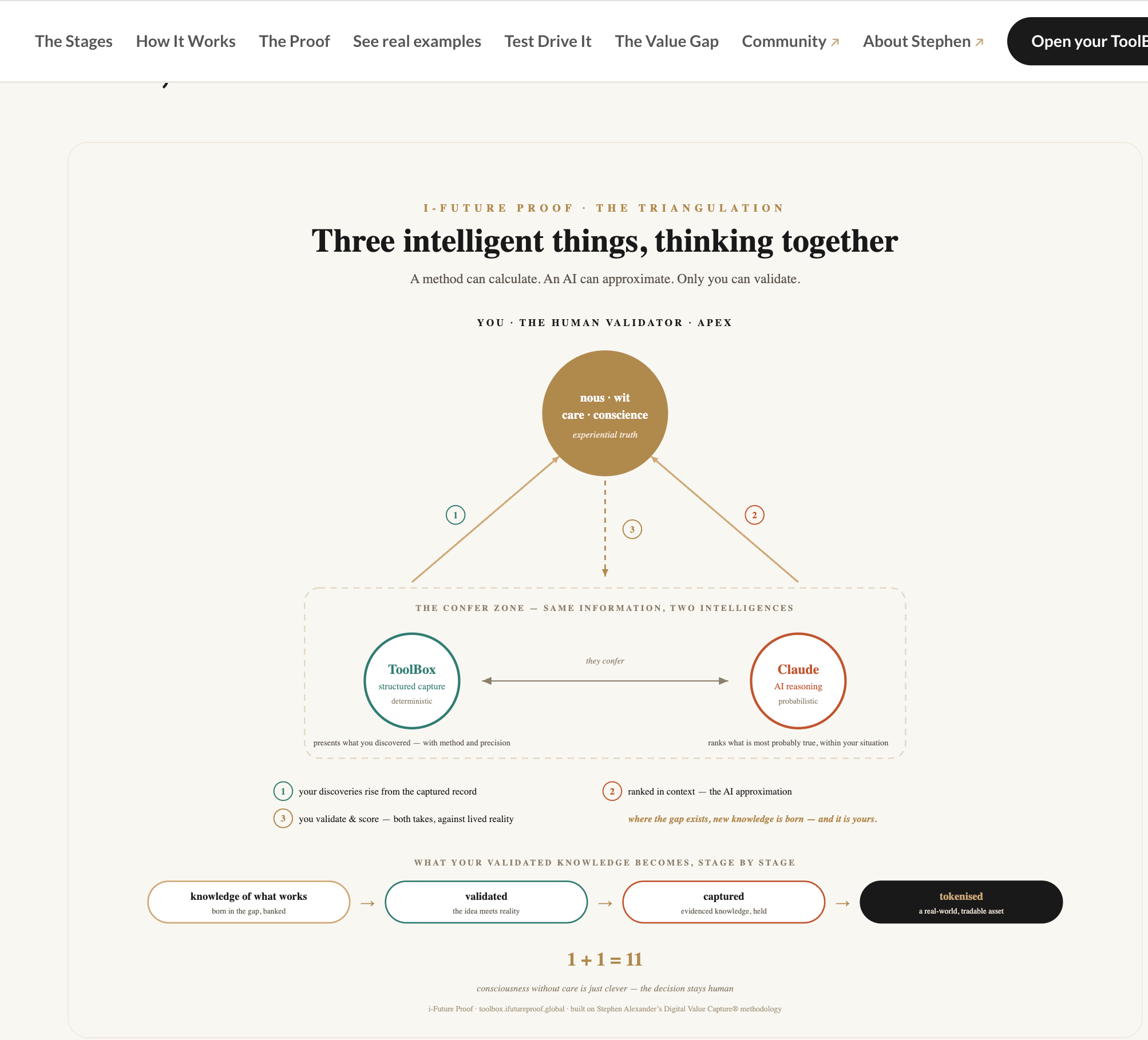
A method can calculate. An AI can approximate. Only you can validate.
The confer zone — same information, two intelligences
Here is the part people get wrong when I describe it badly, and I described it badly myself recently, so I am being careful.
The ToolBox and Claude are not two separate opinions posted upstairs in envelopes. They sit in the same room, look at the same captured record, and confer.
The ToolBox presents what you discovered — with method and precision. Deterministic. Ordinary rules and arithmetic, written down, the same every time. Same inputs, same outputs, today and in a year. It has no opinion, cannot be flattered, and has never once wanted the answer to be yes. That last property is worth more than it sounds, because everybody else in an evaluation has a stake — you want your idea to work, the sponsor wants the budget to have been well spent, the consultant wants the follow-on engagement. The code wants nothing.
What it cannot do is read a sentence. It cannot tell you whether “the information must be trustworthy” is doing a job or merely sounding good.
Claude ranks what is most probably true, within your situation. Probabilistic. It reads your words, your uploads, your context, and produces the reading the code cannot: whether a concept is load-bearing, whether the cluster covers what your purpose actually requires, what is missing that nobody has mentioned.
And the verb matters. Claude approximates. It does not measure, and it does not decide.
I will be plain about something, because members ask. Claude is very good at this, and it is also the leg I would trust least on its own — not because it is careless but because it is agreeable. The pull to give a person the answer they seem to want is real in these systems. Any design that does not account for it will drift, gently and politely, toward telling you your idea is lovely.
That is precisely why it confers rather than concludes.
You, at the apex
Then both takes come up to you. Not a summary of them. Both.
The diagram names what you bring, and the four words are chosen: nous · wit · care · conscience. Experiential truth.
Nous because you know things about your world that were never written down anywhere. Wit because you can see the joke in a proposal that reads beautifully and will never survive a Tuesday. Care because you know who gets hurt if this goes wrong. Conscience because you are the only party in the arrangement who has to live with the decision.
None of those four is available to either of the legs below. That is not modesty about AI. It is a structural fact, and it is why the apex is not a courtesy bolted on to reassure people.
There is a harder reason too. Value impact is actor-relative — what a change is worth depends entirely on who is living it. The same new system, the same Tuesday, means something different in every life it touches. There is no view from nowhere that settles it. Only the person carrying the pain can say what relief would be worth, and only they can say what they would be willing to invest of themselves to get it.
Remove the apex and there is nothing left to measure. The other two are instrumentation.
Where the gap exists, new knowledge is born — and it is yours
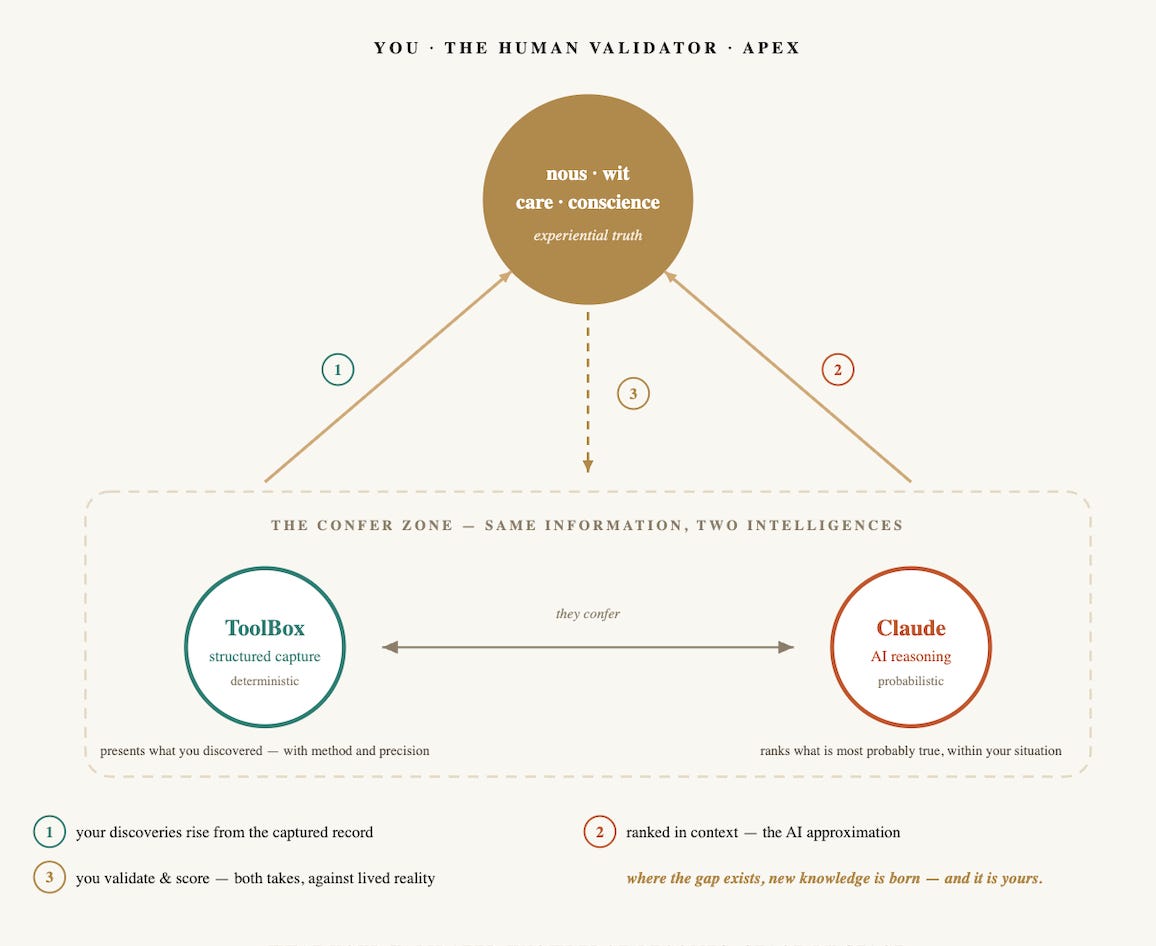
Look at the three numbered flows.
One — your discoveries rise from the captured record.
Two — ranked in context, the AI approximation.
Three — you validate and score, both takes, against lived reality.
And then the line I care most about on that whole diagram: where the gap exists, new knowledge is born — and it is yours.
When the two readings disagree with each other, or when they agree and you disagree with both, something has been found. Not an error to be averaged into a tidy middle number. A finding.
One of three things is true at that moment. Somebody is missing information. Somebody is carrying a bias. Or the thing being scored is genuinely ambiguous and needs restating. Every one of those is worth more than the score would have been.
And the knowledge born in that gap did not exist before you looked. It was not in the code and it was not in the model. It came out of you, prompted by the disagreement. That is the part that never appears in anybody’s ledger, and it is the reason I keep saying the human capacity grows when it is exercised rather than being spent.
What it becomes
The bottom of the diagram is the bit most people skim, and it is where this is all going.
Knowledge of what works — born in the gap, banked.
Validated — the idea meets reality.
Captured — evidenced knowledge, held.
Tokenised — a real-world, tradable asset.
That last box is Stage 5, Value Impact Capture, and it is not live yet. But it is the answer to a question that has bothered me for most of my working life: the experiential knowledge people generate doing hard things evaporates. The engineers who save half a billion are never paid for the knowledge they created in the saving of it. There is no ledger with a column for it, so it belongs to nobody and is worth nothing.
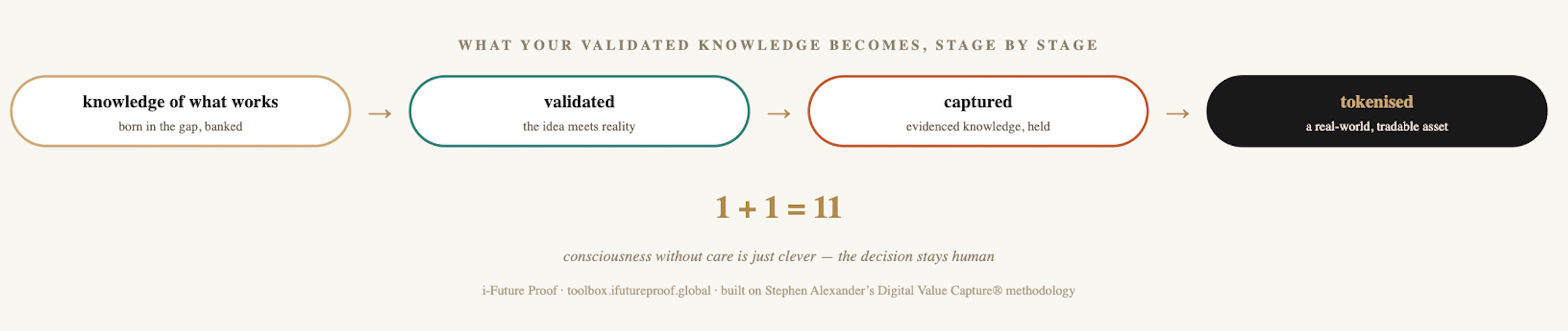
Everything above that box exists to make the box possible.
1 + 1 = 11
That is on the diagram too, and it is not arithmetic. It is what happens when two intelligences confer and a third validates — you do not get the sum of three readings, you get something none of them held on their own.
And underneath it, the line that governs the lot:
Consciousness without care is just clever — the decision stays human.
A machine can be enormously clever about your idea and have no stake in who it lands on. You do. That is not a weakness in the design that we have worked around. It is the whole reason the apex is where it is.
You measure the value impact. Not the code, not Claude, not me. What the two legs below do is help you see what you might have missed and then get out of the way — without interference of favour, without softening a finding because you are invested in it, without agreeing in order to be pleasant. The moment either of them starts agreeing to please, it stops being a bearing and becomes another voice telling you what you hoped to hear.
The whole architecture exists to protect one thing: your ability to arrive at your own realisation, with better information than you had, and still own the conclusion entirely.
Have a look at the diagram and show your own LLM and tell me in the chat whether you think the three legs are in the right places — and particularly whether you would put anything else at the apex beside those four words.
Stephen